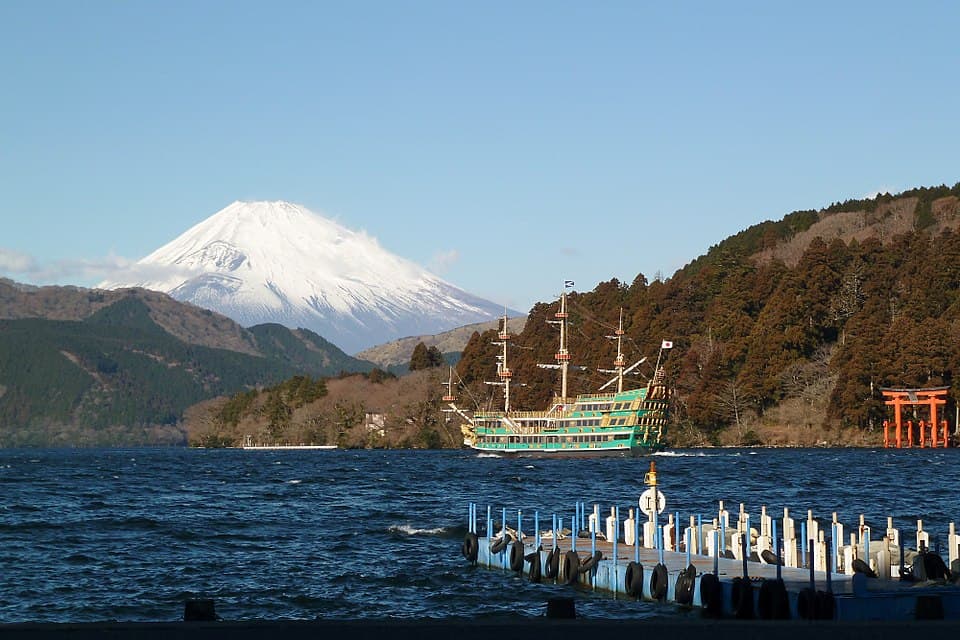
Hakone Complete Guide: Hot Springs, Mt Fuji Views & the Classic Loop
2026-03-11
Guide to Action
Overview
Hakone is the single best day trip or overnight escape from Tokyo. Situated in Kanagawa Prefecture about 85 km southwest of the capital, it packs an astonishing amount into a relatively small area: an active volcanic valley, a caldera lake with views of Mount Fuji, a lakeside Shinto shrine, a world-class open-air art museum, and some of Japan's finest hot spring resorts.
On a clear day — most common in autumn and winter — Mount Fuji looms above Lake Ashi with almost theatrical perfection. Even on cloudier days, the sulfurous steam rising from Owakudani, the red torii gate rising from the lake at Hakone Shrine, and the pirate ship cruising across the water make for an unforgettable scene.
Best for: Anyone based in Tokyo who wants mountains, nature, hot springs, and culture without a long journey.
Kanagawa's volcanic resort town — gateway to Mount Fuji views, hot springs, and one of Japan's most scenic sightseeing loops.
Getting There
Romancecar (Recommended)
The fastest and most comfortable option is the Odakyu Romancecar from Shinjuku Station directly to Hakone-Yumoto Station.
- Time: approximately 85 minutes (no transfers)
- Cost: Base fare plus a reserved-seat surcharge; check the current Odakyu fare when booking
- Booking: Reserve via the Odakyu app, at Shinjuku Station ticket office, or on the day if seats remain
The Romancecar has wide windows, forward-facing seats, and a cafe trolley service. It's genuinely enjoyable as part of the trip, not just a means to an end.
Regular Odakyu Express + Bus
If you don't book the Romancecar in advance, take the Odakyu Limited Express (Odakyu Line from Shinjuku) to Odawara, then transfer to the Hakone Tozan Bus or Hakone Tozan Railway to Hakone-Yumoto.
- Time: approximately 100–110 minutes total
- Cost: significantly cheaper, especially with the Hakone Free Pass
| From | Route | Time | Cost |
|---|---|---|---|
| Shinjuku | Romancecar (direct) | ~85 min | Varies by fare + reserved seat |
| Shinjuku | Odakyu local/express + transfer | ~110 min | Check current fare |
| Tokyo Station | Shinkansen to Odawara + Hakone Tozan | ~75 min | Check current fare |
Hakone Free Pass (Highly Recommended)
The Hakone Free Pass (箱根フリーパス) is a multi-day pass covering most of the transport you'll use in the area.
- Price: ¥7,100 from Shinjuku (2-day), ¥7,500 (3-day)
- Covers: Odakyu trains to/from Shinjuku, Hakone Tozan Railway, Hakone Tozan Bus, Hakone Ropeway, Lake Ashi cruise boat, Hakone Tozan Cable Car
- Also includes: Discounts at many museums and attractions
The Hakone Free Pass usually pays for itself quickly if you plan to do the full loop. Exact point-to-point fares change, so compare with the current official price list before you travel.
The Classic Loop Route
The "Hakone Loop" is a circular sightseeing route that hits all the major attractions using different modes of transport. Most visitors travel it counterclockwise starting from Hakone-Yumoto.
Recommended Order (counterclockwise)
- Hakone-Yumoto Station — Start here. Check in to your hotel if staying overnight, or leave luggage at the coin lockers.
- Hakone Tozan Railway — Board the switchback mountain railway toward Gora (~40 min, ¥530). The train itself is an attraction — it zigzags up steep mountain grades with glimpses of hydrangeas in June and maple leaves in autumn.
- Gora — Transfer to the Hakone Tozan Cable Car to Sounzan (~10 min, covered by Free Pass).
- Sounzan → Togendai (Ropeway) — The star of the loop. The gondola glides over Owakudani's volcanic valley for about 30 minutes. Stop at Owakudani Station (mid-point) to explore the crater area and eat black eggs.
- Togendai → Moto-Hakone (Lake Ashi cruise) — Board the pirate ship for the 30-minute cruise across Lake Ashi. On clear days, Mount Fuji appears perfectly framed above the lake. Disembark at Hakone-machi or Moto-Hakone.
- Hakone Shrine — A 10-minute walk from Moto-Hakone pier. Visit the famous red torii gate rising from the lake.
- Bus back to Hakone-Yumoto — Hakone Tozan Bus from Moto-Hakone runs every 20–30 minutes (~35 min, covered by Free Pass).
The ropeway frequently closes due to wind or volcanic activity — sometimes for months at a time. Check the official Hakone Ropeway website before your trip. If closed, a replacement bus runs between Sounzan and Togendai.
Timing Tips
- Leave Tokyo by 8:00–8:30 AM to avoid crowds at Owakudani and catch the morning light on Fuji.
- Do the ropeway and Owakudani before noon — afternoon clouds often obscure the crater views.
- Lake Ashi cruise in the afternoon tends to have softer light for photos.
- Allow at least 7–8 hours for the full loop at a comfortable pace.
Key Attractions
Owakudani (大涌谷)
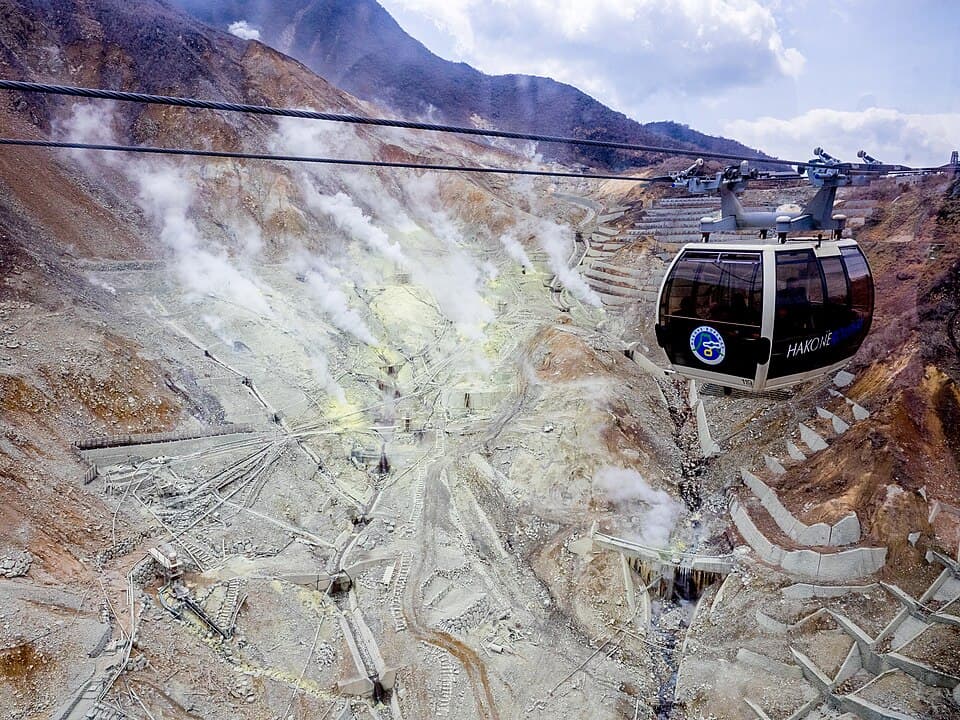
Hakone's active volcanic valley — sulfur vents, steaming craters, and the legendary black eggs that supposedly add 7 years to your life.
Owakudani ("Great Boiling Valley") is the most dramatic stop on the loop. Formed by a volcanic eruption approximately 3,000 years ago, the area is still geothermally active with fumaroles hissing sulfurous steam across a barren, ashen landscape.
The main attraction here — besides the eerie landscape — are the kuro-tamago (黒卵), eggs boiled in the sulfuric hot spring water that turns their shells jet black. According to local legend, eating one adds 7 years to your life. A bag of 5 eggs costs ¥600. They taste like regular hard-boiled eggs, but you'll want them anyway.
A short walking trail leads up through the crater area (note: some sections may be restricted during elevated volcanic activity). The views down into the valley from the observation platform are excellent.
Hours: 9:00–17:00 (last entry 16:30) | Access: Owakudani Station on the Hakone Ropeway
Hakone Shrine (箱根神社)
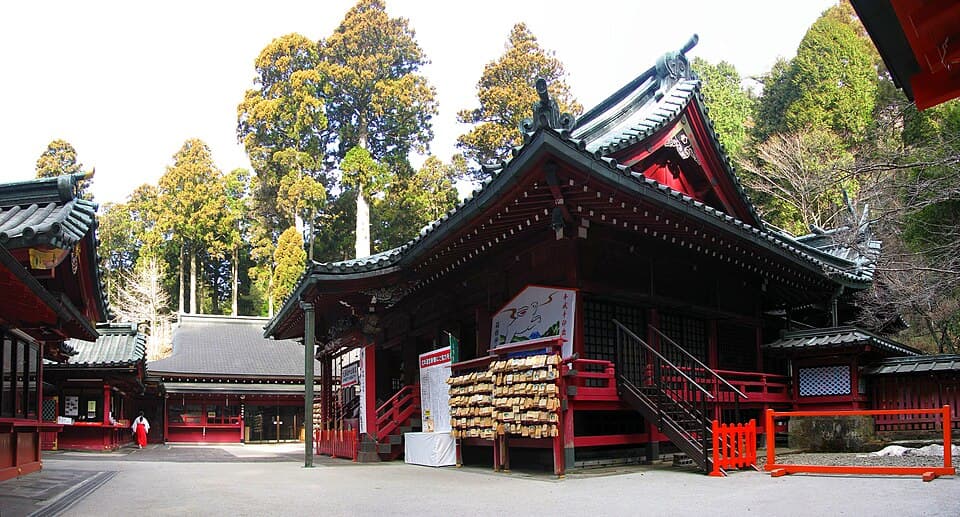
A 1,200-year-old shrine on the forested shores of Lake Ashi, famous for its torii gate rising dramatically from the lake's surface.
Founded in 757 AD, Hakone Shrine sits in ancient cryptomeria forest on the western shore of Lake Ashi. The shrine itself is serene and atmospheric — red lacquered buildings framed by towering cedar trees — but what everyone comes to photograph is the Heiwa no Torii (Peace Gate): a large vermilion torii gate standing directly in the lake, visible from the cruise boat and from the lakeside path.
The torii is at its most photogenic in calm, clear weather when it reflects perfectly in the still water. At dusk it's also remarkable, lit softly against the fading light.
Allow 30–45 minutes for the shrine and lakeside walk.
Hours: Open 24 hours (main hall 8:30–17:00) | Access: 10-minute walk from Moto-Hakone pier
Lake Ashi (芦ノ湖)
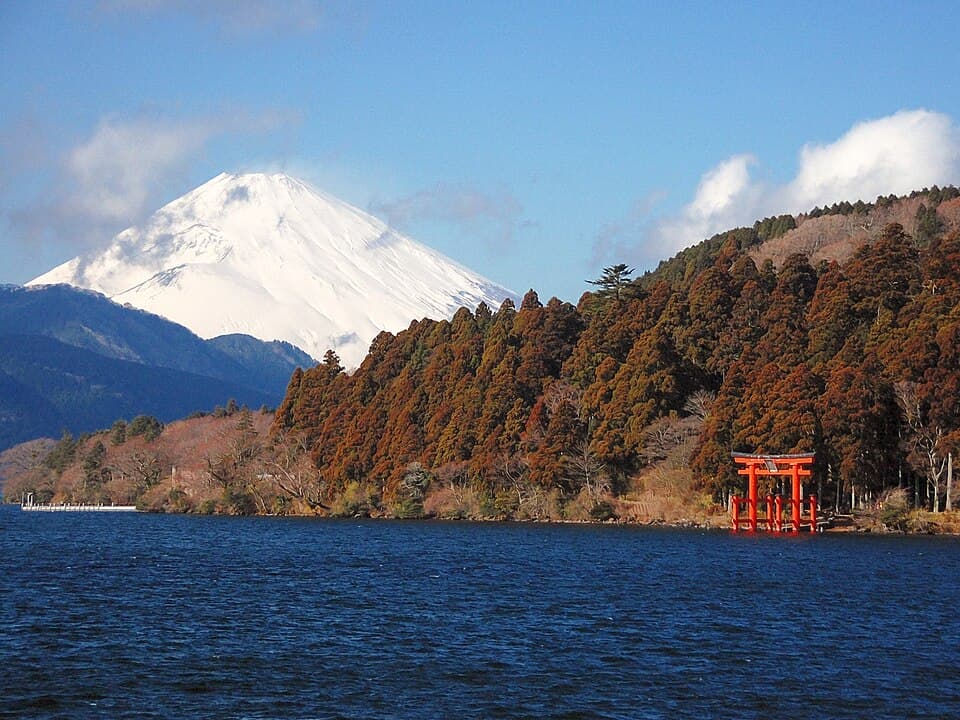
A caldera lake formed by a volcanic eruption, offering stunning views of Mount Fuji on clear days and famous for its pirate ship cruise boats.
Lake Ashi was formed by a volcanic eruption about 3,000 years ago and sits at an altitude of 725 meters. On clear days — most reliable in autumn and winter — Mount Fuji rises majestically above the northwestern shore, its snow-capped cone reflected in the calm water.
The Hakone Sightseeing Cruise operates three "pirate ship" vessels (Vasa, Royal II, and Victory) modeled after 17th–18th century European warships. They're genuinely theatrical and excellent for photos. The cruise between Togendai and Hakone-machi/Moto-Hakone takes about 30–40 minutes and is covered by the Hakone Free Pass.
Cruise hours: First departure around 9:30, last departure around 17:00. Runs every 30–40 minutes.
Hakone Open Air Museum (箱根彫刻の森美術館)
Japan's first open-air museum (opened 1969) sits on the hillside between Chokoku-no-Mori and Kiga stations on the Hakone Tozan Railway. The grounds hold over 120 sculptures by Picasso, Moore, Rodin, Calder, and others, set among manicured gardens with mountain views.
There's also an impressive Picasso Pavilion with 319 works and a stained-glass tower children can climb inside. Budget 90 minutes to 2 hours.
Hours: 9:00–17:00 | Admission: Same-day adult admission is currently ¥2,000, with cheaper online tickets available
Onsen Guide
Hakone is one of Japan's premier onsen destinations with multiple distinct hot spring areas, each drawing from different volcanic sources.
Hakone-Yumoto
The most accessible area, right at the base of the Tozan Railway. Ideal for a quick soak before or after the loop.
- Tenzan Tohji-kyo (天山湯治郷) — One of the best day-use facilities in the area. Multiple indoor and outdoor baths, rotenburo (open-air baths) in a forested valley setting. Adult admission is currently ¥1,450, cash only, open 9:00–23:00 (last reception 22:00). The official policy allows tattooed guests only when visiting alone, so check the latest rules before you go.
- Hakone-Yumoto Onsen Spa (日帰り温泉) — Various day-use bathhouses around the station area starting from ¥800.
Gora & Sengokuhara
Higher elevation areas with more upscale ryokans and resort hotels. The thermal waters here tend to be sulfuric or alkaline — excellent for skin.
Miyagino / Tonosawa
Quieter, older spa towns in the mountains above Hakone-Yumoto. Less touristy, more authentic ryokan atmosphere.
Onsen Etiquette
Basic onsen rules: Wash thoroughly at the shower stations before entering the bath. No swimwear — you bathe completely nude. Tie up long hair. No towels in the water (use a small towel on your head if you like). Tattoos are prohibited at most traditional onsen facilities.
Private baths (kashikiri-buro): If you have tattoos or are uncomfortable with shared bathing, many ryokans and some day-use facilities offer private family baths (¥1,500–¥3,000 for 45–60 minutes). Book in advance.
Food & Local Flavors
Kuro-tamago at Owakudani
Already mentioned above — the must-eat in Hakone. Five black eggs for ¥600 at the stalls near Owakudani Station. Eat them with a sprinkle of salt.
Hakone Bakery
Bakery & Table Hakone near Hakone-machi pier is a charming lakeside bakery with excellent breads, pastries, and views of Lake Ashi. Arrive early — popular items sell out. A slice of Fuji-shaped cheesecake (¥600) is worth the small indulgence.
Kamaboko (かまぼこ)
Odawara, the gateway city to Hakone, is Japan's most famous kamaboko (fish cake) production area. Look for kamaboko shops in Hakone-Yumoto station — Suzuhiro Kamaboko (鈴廣かまぼこ) has an excellent shop here with tastings, gift sets, and a cafe.
Tofu & Yuba
The mountain water in Hakone produces exceptionally clean, soft tofu. Several restaurants in Gora and Moto-Hakone serve yuba (tofu skin) kaiseki meals. Naraya Café in Miyagino serves yuba dishes and has a free foot bath.
Hakone Beer (箱根ビール)
A local craft brewery producing pilsners and ales. Available at restaurants throughout Hakone, particularly around Gora.
Most restaurants in Hakone stop serving lunch around 14:00–14:30. If you're mid-loop, grab a meal at Owakudani (the restaurant there is adequate if uninspired) or plan your loop so you reach Moto-Hakone by 13:30.
Day Trip vs Overnight
Day Trip
Pros: Save money on accommodation; possible to see all major sights in one long day; you can sleep in your own bed.
Cons: The most atmospheric time at Lake Ashi and Hakone Shrine is early morning (before 9:00), which is impossible on a day trip from Tokyo. Onsen time gets squeezed. The loop can feel rushed.
Day trip verdict: Absolutely doable and satisfying, but you'll feel like you could have used another few hours.
Overnight (Recommended)
Pros: Wake up to the mirror-calm lake at dawn; enjoy a full ryokan experience with kaiseki dinner and multiple baths; see the ropeway in different light; avoid the day-trip rush.
Cons: Accommodation costs. Budget ryokans in Hakone-Yumoto start around ¥8,000–¥12,000 per person including dinner and breakfast; mid-range lakeside ryokans run ¥20,000–¥40,000 per person.
Overnight verdict: If budget allows, one night at a ryokan transforms this from a good day trip into a genuinely memorable Japanese experience.
Ryokan Recommendation Areas
- Hakone-Yumoto: Most affordable, best transport connections. Good for first-timers.
- Sengokuhara: More rural feel, large resort hotels and some excellent ryokans. Farther from the railway.
- Lake Ashi shore (Hakone-machi / Moto-Hakone): Stunning lake views. Higher prices but worth it for the early morning Fuji view.
Where to Stay
Plan Your Stay
Add these spots to your trip, then find the best hotel area near all of them.
FAQ
More spots to explore in Hakone:
A volcanic caldera lake with iconic Mount Fuji views and scenic pirate ship cruises across its glassy surface.
Find the best hotel area for this guide
4 spots are already loaded so you can refine the hotel base below.
Plan Your Stay
Add these spots to your trip, then find the best hotel area near all of them.
More Guides
Arashiyama Complete Guide
Bamboo groves, river views, temples, and monkeys — everything you need for a perfect day in Kyoto's western mountain district.
Mount Takao Beginner's Hiking Guide
Everything you need to know for your first hike up Mount Takao — trails, access, tips, and where to stay nearby.
Shinjuku Complete Guide
Everything you need for Tokyo's busiest district — Kabukicho nightlife, Golden Gai bars, Omoide Yokocho, Shinjuku Gyoen, and the free TMG observatory.
Akihabara & Otaku Culture Guide
Your complete guide to Tokyo's Electric Town — anime shops, arcades, maid cafés, electronics, and nearby Kappabashi Kitchen Street.
Asakusa & Senso-ji Temple: The Complete Visitor's Guide
Everything you need to know to explore Tokyo's oldest and most visited temple — access, highlights, street food, and where to stay in Asakusa.
Dotonbori & Shinsekai Food Guide
Osaka's two legendary food districts — neon-lit Dotonbori and retro Shinsekai with its iconic Tsutenkaku Tower. Your guide to the best street food, takoyaki, and kushi-katsu.
Fushimi Inari & Kiyomizu-dera Guide
Kyoto's two most iconic sights — the endless vermillion torii gates of Fushimi Inari and the wooden stage of Kiyomizu-dera — plus Gion and Nishiki Market.
Hakata & Fukuoka City Guide
Explore Fukuoka — Kyushu's largest city. From Hakata Station's ramen street to Nakasu yatai stalls, Tenjin underground shopping, and historic Kushida Shrine. The ultimate guide to Japan's food capital of the south.
7 Days in Japan: Where to Stay in Tokyo, Kyoto, and Osaka
A practical 7-day Japan hotel base guide for first-time travelers from the US. Decide how many nights to spend in Tokyo, Kyoto, and Osaka, and choose areas that reduce transit stress.
Kamakura Day Trip Guide: Ancient Capital, Great Buddha & Enoshima
Everything you need for a perfect day trip to Kamakura — the Great Buddha, Tsurugaoka Hachimangu, bamboo temples, hiking trails, and an optional Enoshima extension.
Kyushu 2-Day & 3-Day Model Itinerary
The perfect Kyushu itinerary covering Fukuoka, Dazaifu, Yufuin, Beppu hot springs, and optional day trips to Kumamoto or Nagasaki. Plan your multi-day Kyushu adventure.
Nara Day Trip Guide
Friendly deer, the Great Buddha, ancient shrines, and peaceful parkland — your complete guide to visiting Nara from Osaka or Kyoto in one day.
Nikko Day Trip Guide
UNESCO World Heritage temples, stunning waterfalls, and highland lakes — your complete guide to visiting Nikko from Tokyo in one unforgettable day.
Osaka Castle & Nakanoshima Guide
Osaka's iconic castle, its surrounding park, and the elegant riverside island of Nakanoshima — history, culture, and city views in one walk.
Osaka, Kyoto & Nara 3-Day Itinerary
The perfect 3-day Kansai itinerary covering Osaka's street food, Kyoto's temples and bamboo groves, and Nara's friendly deer — with transport tips and hotel picks.
Shibuya & Harajuku Neighborhood Guide
Tokyo's ultimate youth culture epicenter — from the world-famous Scramble Crossing to kawaii fashion on Takeshita-dori and calm forest walks at Meiji Shrine.
Shinjuku vs Ginza vs Asakusa: Which Tokyo Area Is Best?
A practical comparison of Shinjuku, Ginza, and Asakusa for Tokyo hotels. Choose the right area by nightlife, budget, comfort, airport access, sightseeing, and first-time travel style.
Tokyo Cherry Blossom Guide: Best Spots & Timing
Plan the perfect hanami in Tokyo. Discover the best cherry blossom spots, bloom forecasts, night sakura events, and essential tips for spring in Japan.
Tokyo Disney or Central Tokyo: Where Should You Stay?
Should you stay near Tokyo Disney Resort, Tokyo Station, Ginza, Shinjuku, or Tokyo Bay? A practical hotel area guide for Disney plus Tokyo sightseeing.
Where to Stay in Tokyo for a First Trip: Best Hotel Areas
A practical first-time Tokyo hotel area guide for travelers from the US. Compare Shinjuku, Ginza, Asakusa, Ueno, Shibuya, and Tokyo Station by itinerary, airport access, budget, and comfort.
Tokyo Hotel Area by Itinerary: Where to Stay Based on Your Plans
Choose a Tokyo hotel area based on the places you will actually visit. Match common first-time itineraries to Shinjuku, Ginza, Asakusa, Ueno, Shibuya, Tokyo Station, and Disney-area stays.
Tokyo 1-Day, 2-Day & 3-Day Model Itinerary
A practical guide to spending 1, 2, or 3 days in Tokyo — covering temples, pop culture, food markets, and iconic landmarks with timing and transport tips.
Tokyo Shopping Guide: Ginza, Harajuku & Akihabara
From luxury boutiques in Ginza to kawaii fashion in Harajuku and electronics in Akihabara — your complete guide to shopping in Tokyo's best districts.
Tokyo Station, Marunouchi & Ginza Guide
From the iconic red-brick station to the Imperial Palace, luxury Ginza shopping, and Tokyo Tower — explore central Tokyo's most elegant district.
Ueno, Ameyoko & Yanaka Guide
Museums, markets, and old-town charm — explore Ueno Park's world-class collections, the bustling Ameyoko market, and Yanaka's nostalgic streets.
Where to Stay in Osaka: Best Areas for Every Traveler (2026)
A data-driven guide to the best neighborhoods in Osaka for first-time visitors, foodies, budget travelers, and Kyoto day-trippers. Compare Namba, Umeda, Tennoji, and Shinsaibashi.
Where to Stay in Tokyo: Best Areas for Every Traveler (2026)
A data-driven guide to Tokyo's best hotel neighborhoods with real subway travel times, hotel counts, and nightly rates. Compare Shinjuku, Shibuya, Asakusa, Ueno, Ikebukuro, and more.
Information such as prices, hours, and schedules may have changed. Please verify details on official websites before your visit.